
The Tantive IVTM has very distinctive engines and a large number of them – 11 to be exact. The first of these engines involved in the build is past prototyping and close to completion. It is a milestone for the build as this it the first of the five key components of the ship to completed. There were several lessons learned in the process of building the engine that can be applied to other components of the build. The initial engine versions had the looks but lacked integrity to allow the completed engines to be handled in any way. This completed version is now strong enough to handle for assembly. During my lifting, laying and general manhandling during the photo taking for this post, not a single piece fell off the component.
The journey to complete the engines was somewhat straight forward from a structural perspective but more complex related to the other elements. Besides the structure there three other parts of the engines: The thrust nozzle, the connection arms and the outer hull. It is a constant battle of trying to be efficient (limiting the number of pieces and weight), building something that is durable enough to be handled without falling apart and ensuring that all of the key visual elements of the engines are included. Here are some shots of the finished product along with descriptions.
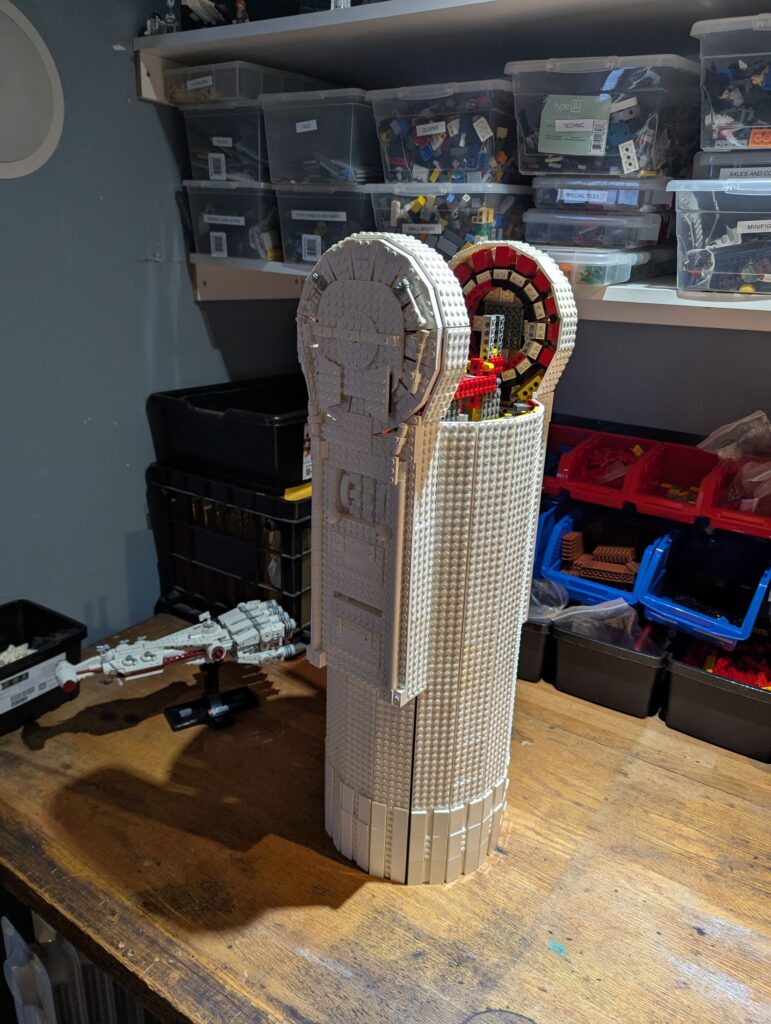
The main engine cylinder is 64 studs long. The length to the center of the circle thing (for lack of a better term) is 72 studs. I had originally calculated this to be 75 studs so it is close to scale. The outer hull is 16 sides of 5 wide plates. I added some plates to the ends to try and simulate the 16 flat panels that show up in the photos and models. The issue with this is that my whole engine is 16 flat panels already! There may be some room for improvement on this design aspect.
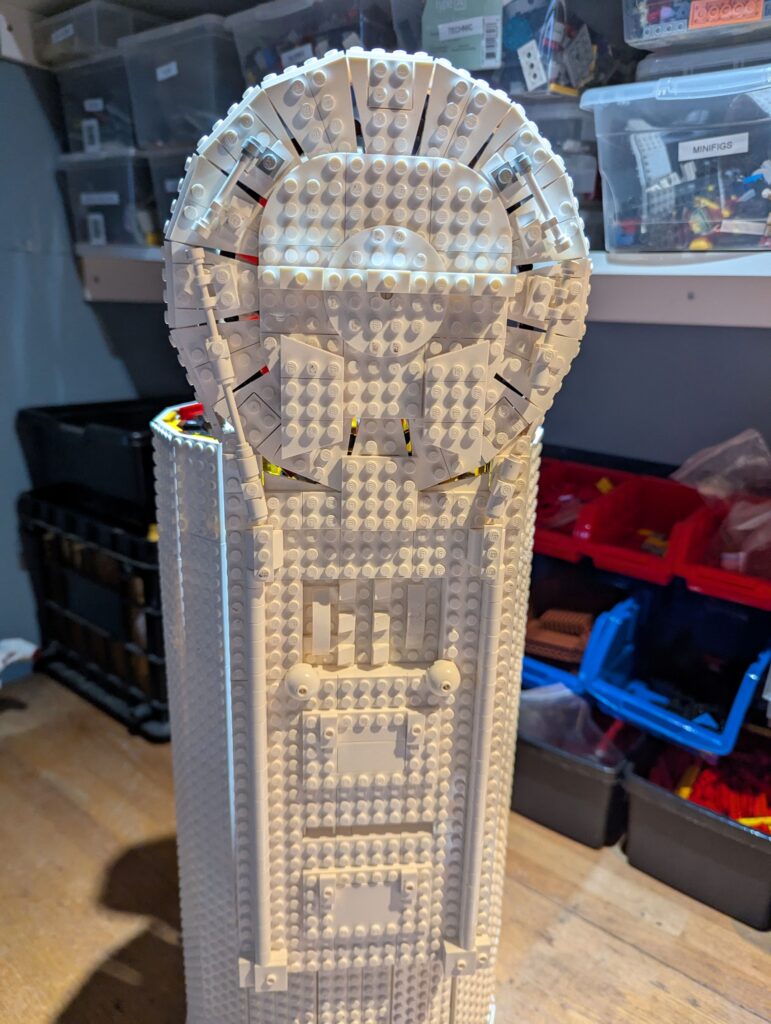
The circle thing portion of the engine connection are was scaled to be 5.3 m or 19 studs in diameter. The constructed diameter is 21 studs. The long rectangular portion from the edge of the circle to the end was scaled at 9.6 m or 34 studs. The constructed rectangle is 32 studs in length. Note that with the circle being two studs larger and the rectangle two studs smaller, the overall length of 53 studs matches the dimensioned length. I completed the greebles on the model but with it all being white, it looks very clinical. Checking reference photos and drawings, there seems to be a lot of ‘wear’ added to the ship in order to break up the stark white appearance. It is very challenging to add wear to LegoTM and it usually involves stickers. One solution might be to sandwich some grey elements into the different layers to provide some relief.
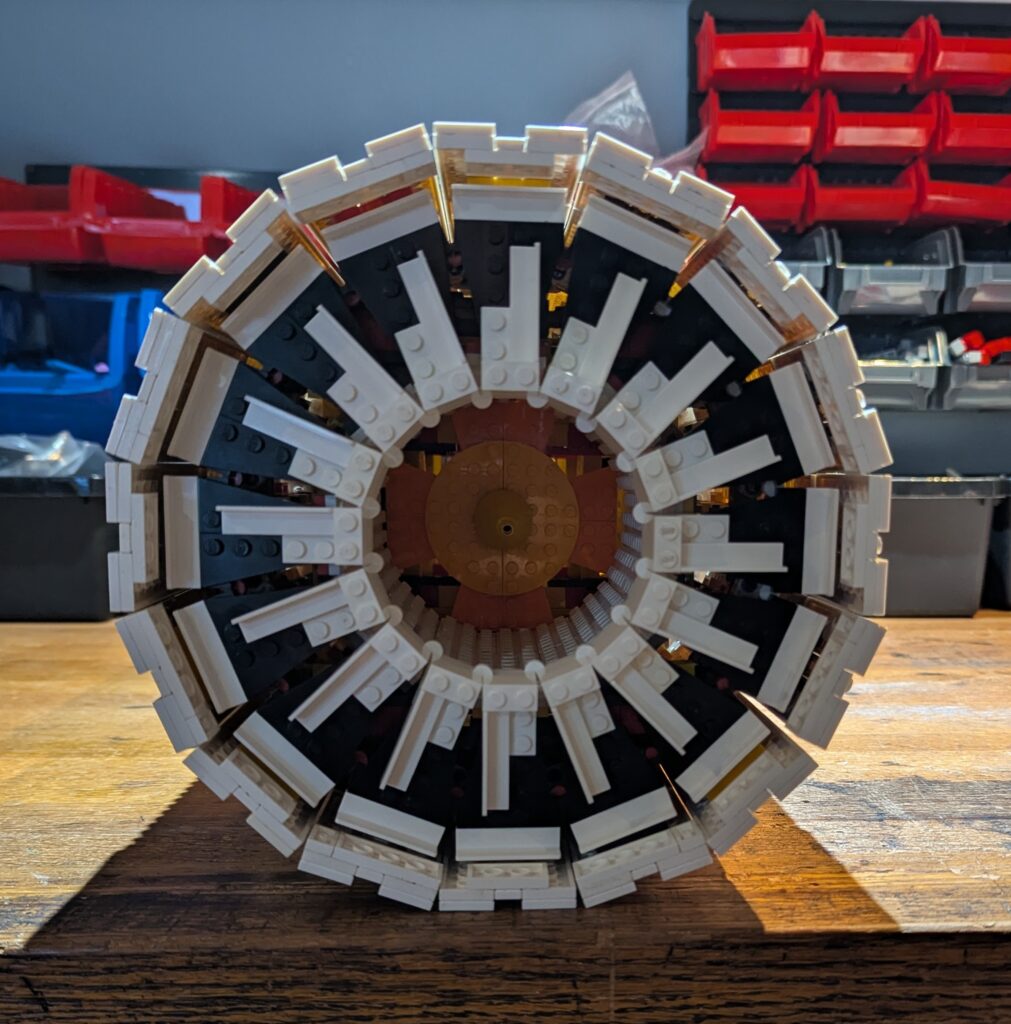
When I started to construct this ship all those years ago, oddly, the engine nozzle was one of the things I looked at and tried to build. I felt that this element would be critical to understanding the limitations of working with Lego circles. The main characteristics of the nozzle are the vanes on the outer circle and the inner cylinder with the “bright light” in it. The engine diameter was scaled at 6.8 m or 24 studs. The constructed diameter of the engine is 26 studs to the outside of the outer haul plates.
The vanes in this photo look a little amateur. I stopped writing this post and experimented a little. In doing so, I doubled the number of vanes from 16 to 32, eliminate the outer white panels and moved the pieces out to eliminate the gap at the edge. It looks much better. The current orange and yellow circle, wings and cones of the engine light provide the hint at power but like so many things, it is tough to replicate the bursting energy we see from the engines in the movies. The proportioning of the inner and outer rings of the nozzle is about a 50/50 split so the constructed version is slightly off in this perspective but there were limitations on the diameter of the inner cylinder.
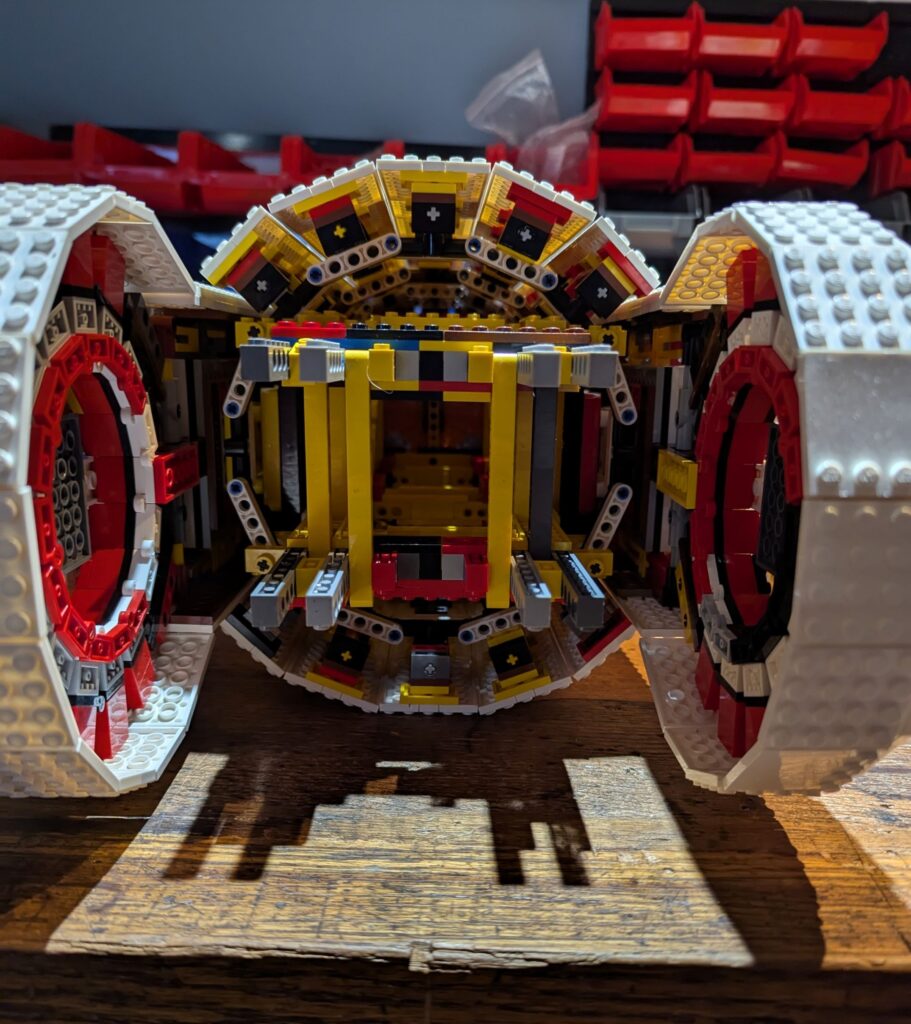
The main longitudinal internal engine structure is a simplified version of the main ship truss structure. It is only two sets of upper and lower chords instead of three sets in the main ship structure. A single set of alternating diagonals is sandwiched between the chords. The height and width are the same for the engine as the main part of the ship. This allows the double set of chords of the engines to insert into the triple set of the main ship structure. I am drafting a new structural post specifically to address the connection of the finished ship components.
The connection of the structural rings to the main internal structure is two sets of TechnicTM bricks that sit across the trusses on either side of the rings. Axles are run through the bricks and the ring to connect them. The axle and plate longerons are connected to the rings with pinned connections. A Cross Block 90° 1 x 2 Axle/Pin (Part 6536 / 40146) is attached to the axle on the ring and is pinned to a connector between the axles of the longerons. The 1×2 bricks with holes on the axle longerons allow plates to be connected along the top of the axles. To create the 5 stud wide sections of outer hull, 2×3 plates are used to connect 2 stud wide and 1 stud wide plates. To center the 5 wide outer hull plates over the longerons, a 1×2 plate is attached to the underside holes in the 2×3 plates of the outer hull. The outer hull is connected to the longerons approximately every 5 studs along its length.
I estimate that the completed engine has about 3000 pieces in it. I plan to complete a LeoCAD model of the engine to get a firm count. As this is the first of 11 engines to be constructed, only another 30,000 pieces to go.