
This part of the Lego® Star Wars® Tantive IV® is likely the most distinctive part of the ship. It is the part of the ship where the corridor battle takes place in A New Hope and has the side air locks. It also houses the communications array. It is also likely the most challenging part of the build as the structure if formed by intersecting 3 cylinders. One cylinder is the main corridor of the ship running from stem to stern, an equally sized cylinder crosses the main corridor ending with the airlocks on each side of the ship and the third, slightly smaller cylinder intersects these two running vertically with the communications array on top.
At this point, the structure is complete and 25% of the outer haul has been placed onto this structure. Here is a picture of the current state of the ship.
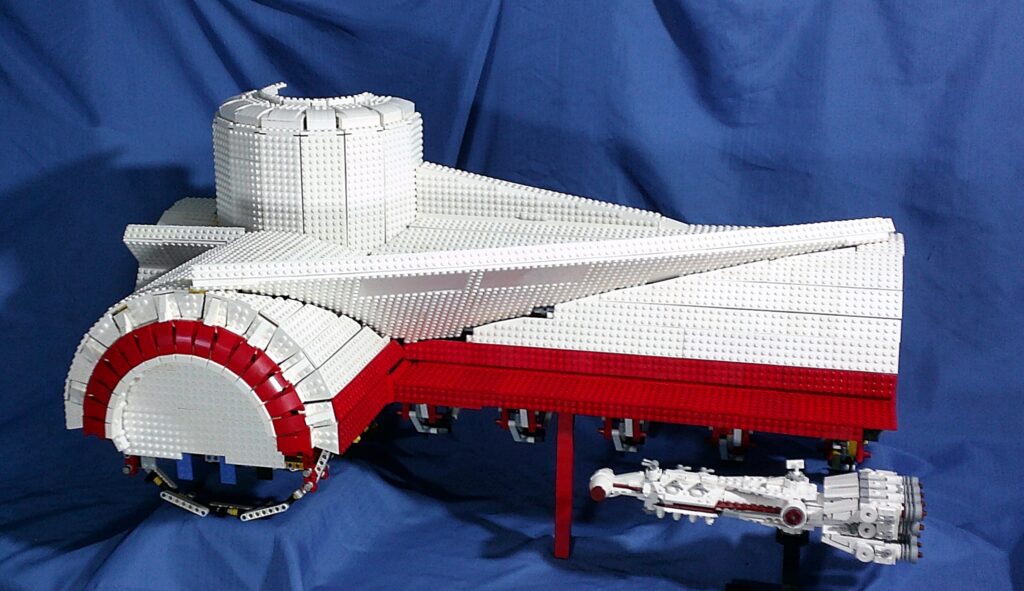
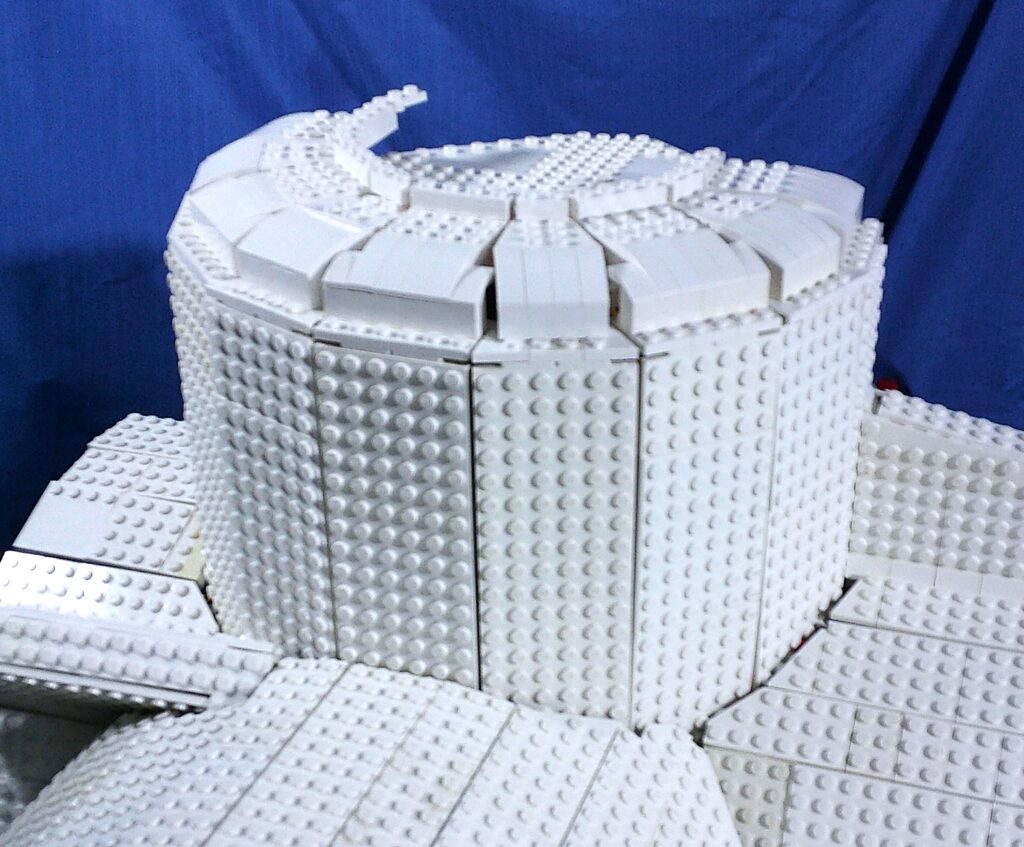
The main sections are 32 sided that alternate between 3 and 4 studs per side. The communications array tower is 16 sided with 6 studs per side. The various fins have been incorporated into the ship. The top and lateral fins are fairly straight forward. These are 2 studs wide and have an internal structure of axles, connectors and plates.
The diagonal fins are much more complicated items. They are oriented at roughly at 40 degrees from just above the centerline of the ship to the top of the main sections. This creates a series of different angles and curves as the fin intersects the outer hull. I made the decision that the fins are all to be embedded into the ship and the outer hull is to match up as best as possible. Overall, I am happy with how this configuration has worked out.
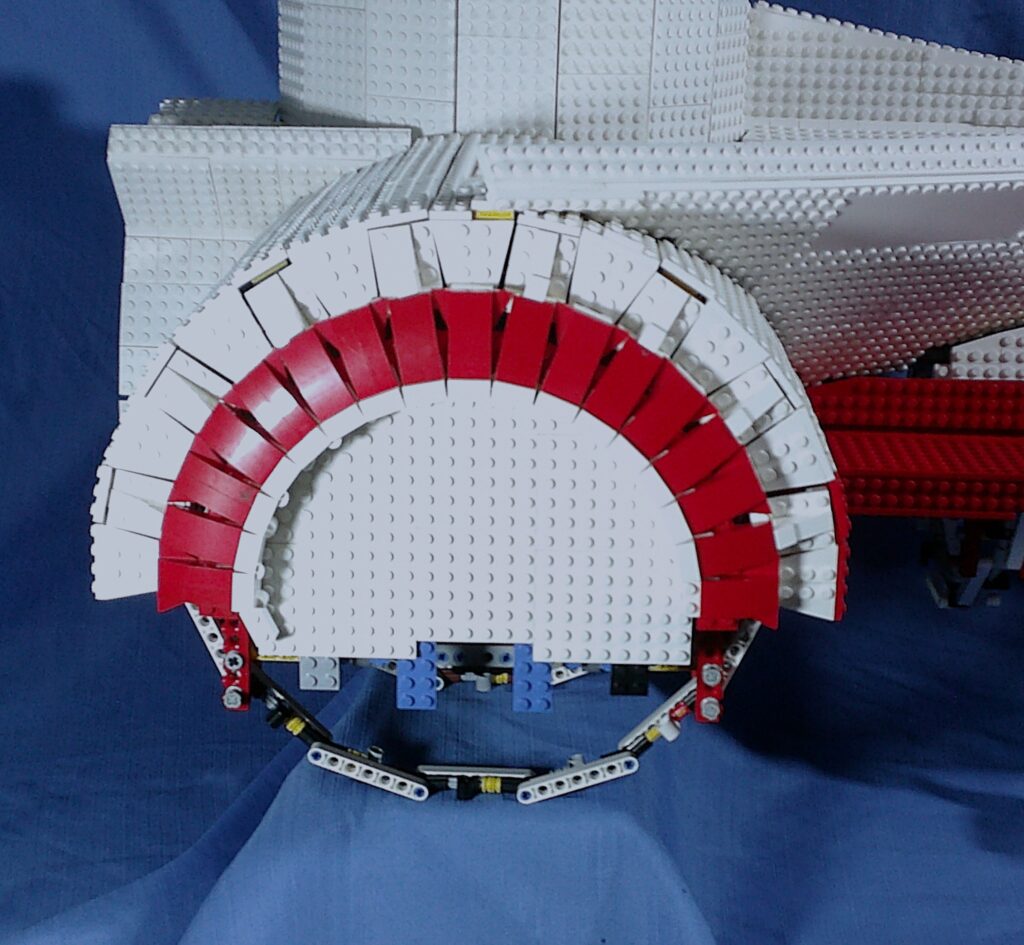
The airlock end is coming together. Creating a 32 stud diameter disk was challenging and took several iterations. The final design I think captures the different lips and rings of the air lock areas. I have also added the red highlights to this area and also to the lateral fins.
The top of the communications array tower presented a similar issue as the air locks and was resolved with a similar design. With only 16 sides, there are a few more gaps and a little rougher feel to it. However, as with the air locks, the different levels and rings are captured. All that is needed now is a square rotating dish.
Now that this first quarter of the design is complete, it will be easy to replicate it for the other three quarters. The design is the same for the other three quarters but mirrored and/or flipped. I am currently making an inventory of the parts that were used for the first quarter and determining what I have in inventory and what I must acquire to complete the other three quarters. The diagonal fin uses a lot of plates. It has an overall surface of about 2000 studs which requires the equivalent of 40 6×8 plates. The outer hull requires about 3000 studs of plates. A lot of these have to 2×3 and 3×3 plates. There are also a significant number of wing and wedge plates required. You probably noted that there are a few gaps where I am missing specific wing pieces as I did not have enough of these specific ones in my inventory.
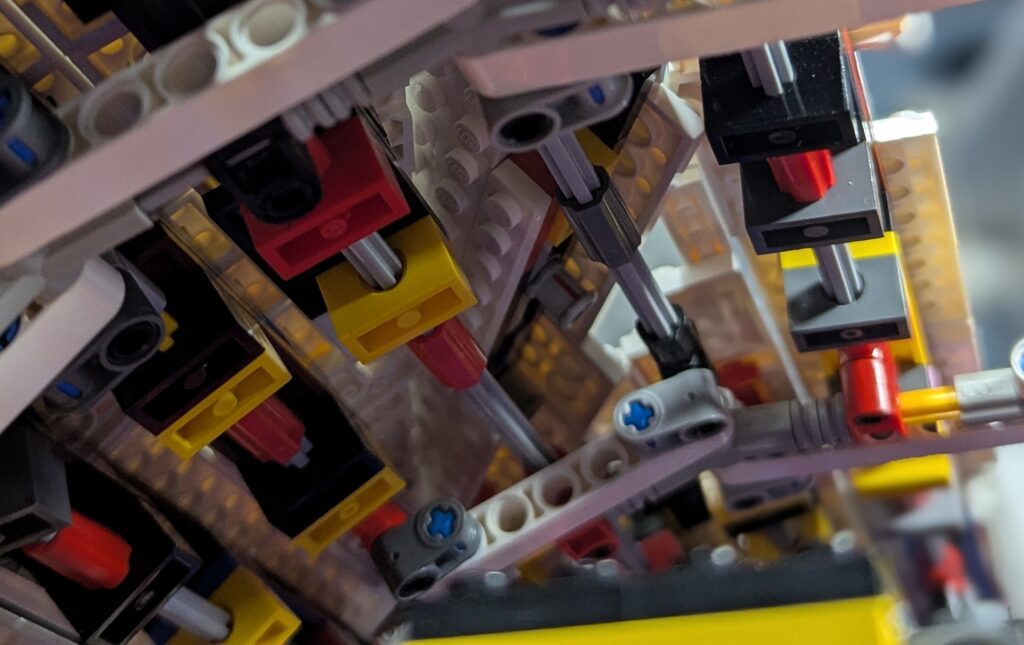
In my previous post about the completion of the first engine, I went into some detail of how the outer hull plates are connected to the inner truss structure and rings. The concept is similar for the cylinders for this part of the ship. One major difference is that the rings are still 16 sided but there are 32 sides on the cylinder. Originally, I used hinge pieces to span between the gap between the sides of the cylinder that were connected by pins to the rings. This was not very strong as any tension or misalignment would make the hinges come apart and the sides would not be equal. To correct this, I did find a way to create 32 pinned connections around the rings to allow a solid connection for all 32 sides.
Thank you for coming by and reading this. I have made progress on completing the structure of the reactor block as well and I will be posting an update on that portion of the ship shortly.